
11 April 2026

When most people picture an Ora Good Cat buyer in Thailand, they picture roughly the same person. Young-ish. Design-conscious. Probably female. Someone who wanted something different — a car that looks like it has a personality. That picture isn't wrong. It's just vastly incomplete.
After analyzing publicly available data from thousands of discussions that took place in 2025, we identified 321 buyers who engaged meaningfully and whose behaviour revealed four distinct buyer profiles. They have different motivations, decision styles, and concerns that could stop them from buying altogether.
Four buyers, one car
The Ora Good Cat attracts four distinct buyer types in Thailand, each representing a meaningfully different share of the customer base.
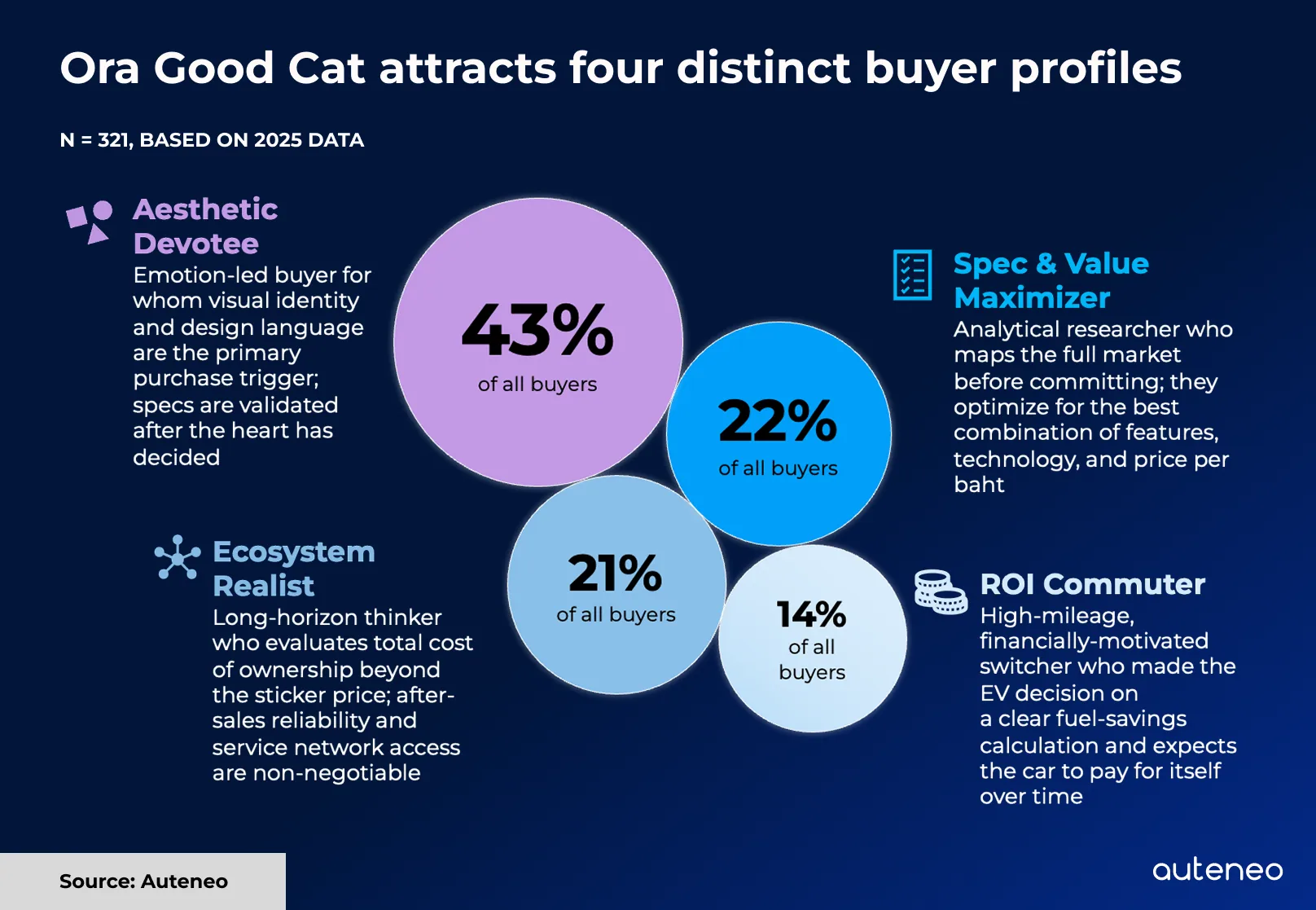
The largest group — more than 40% of all buyers — are what we call Aesthetic Devotees. They are the ones who actually match the mental image most people have of the Good Cat buyer. Design is their entry point, not one factor among many. Specs are validated after the heart has already decided.
Second, at 22% of all buyers, are Spec & Value Maximizers. These are analytical researchers who map the full market before committing. They want the best combination of features, technology, and price per baht — and they will find the answer, because they are very good at looking.
Close behind, at 21%, are Ecosystem Realists — long-horizon thinkers who evaluate total cost of ownership well beyond the sticker price. For them, after-sales reliability and service network access are non-negotiable. They want to know that if something goes wrong eighteen months from now, someone will actually fix it.
And then there are ROI ("Return On Investment") Commuters, at around 14%. They are high-mileage, financially-motivated switchers who made the EV decision on a clear fuel-savings calculation and expect the car to pay for itself over time.
What actually drives each buyer — and what holds them back
Rich online data allows us to understand motivations and concerns of each profile in detail.
The Aesthetic Devotee: design decides, logic follows
The Aesthetic Devotee is more than 80% female — the most gender-skewed of all four personas — and the only group where emotion genuinely leads the decision. Design is their primary motivation at 97%, which is not a figure that leaves much room for anything else. They see the Good Cat, decide they want it, and work backwards from there. Specs are not the starting point. They are the supporting evidence assembled after the heart has already ruled.
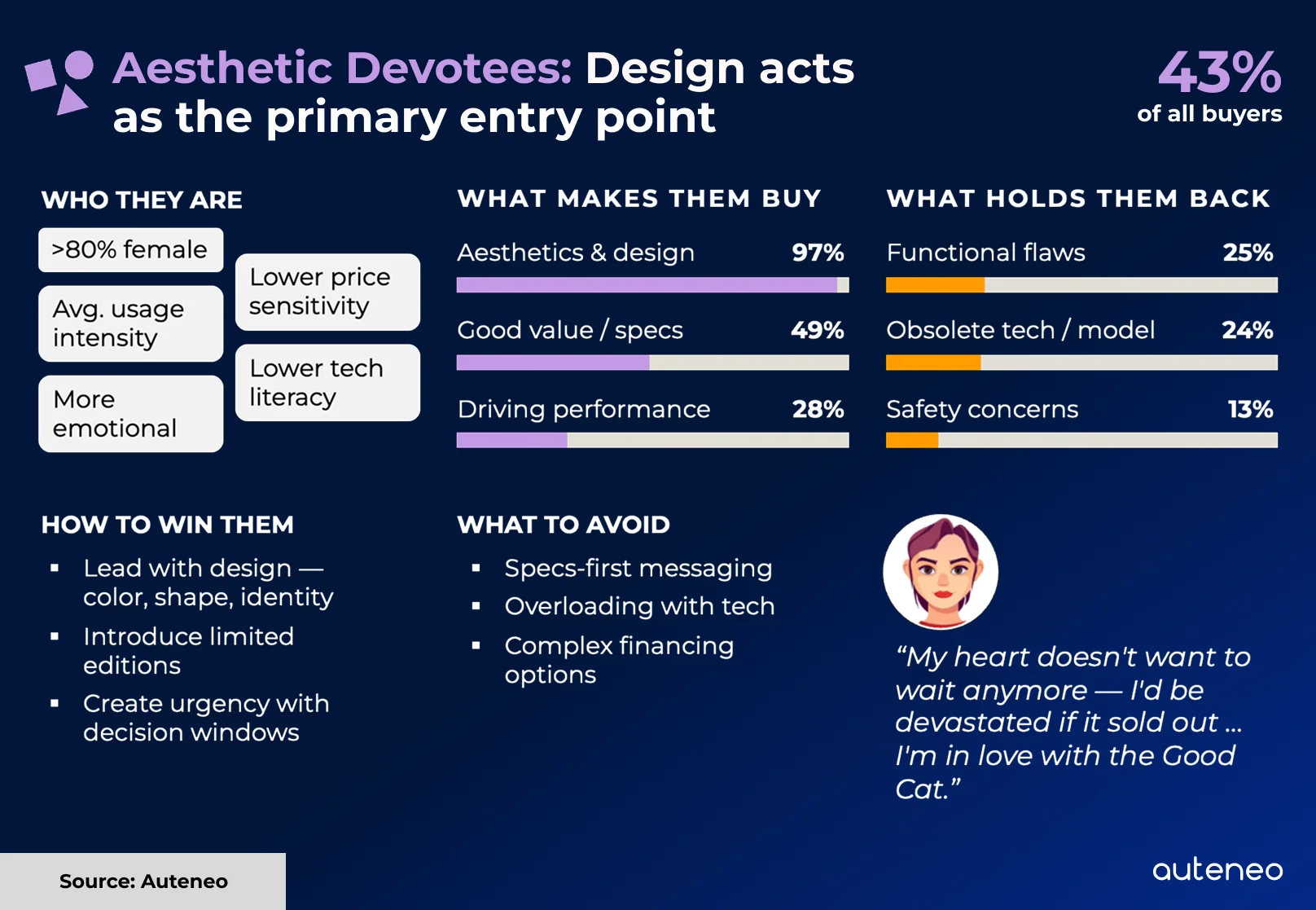
But calling this buyer impulsive would be inaccurate. Good value and specs rank second on their motivation list at 49%, and driving performance third at 28%. These are not afterthoughts — they are the rational architecture that converts emotional attraction into a purchase commitment. The decision is fast once it starts, but it still needs to clear a logical threshold before money changes hands.
This same duality shows up in what holds them back. Their top barrier is functional flaws — specific, tangible issues like the missing rear wiper, limited boot space, or wind noise at speed. That a design-led buyer is most troubled by practical shortcomings is revealing. It suggests that even when design drives the decision, these buyers are quietly running a parallel check: I love how this car looks — but can I actually live with it? The answer needs to be yes before they commit.
The Spec & Value Maximizer: the best value wins the decision
The Spec & Value Maximizer is the most evenly gender-balanced of all four personas — roughly 50:50 men and women — and by far the most rational. They map the full market before committing, compare specifications across competing models with genuine depth, and optimize for the best combination of features, technology, and price. Good value and specs lead their motivations at 65%, followed by tech and modernity at 43% and driving performance at 38%.
What holds them back most acutely is technology and model obsolescence, cited by 45% — the highest single barrier figure across all four personas. This is a buyer who understands that EV hardware evolves rapidly, and fears being locked into yesterday's platform. The impending model refresh in 2026 amplified this concern considerably (It is worth noting that all buyer data in this article was collected in 2025 — the concerns and motivations described reflect that specific market moment). Price and value drop concerns rank second at 17%, followed by battery longevity at 13% — both of which are extensions of the same underlying anxiety: making a financially sound decision that holds up over time.
The Ecosystem Realist: choosing the option with least risk
The Ecosystem Realist is a higher-than-average usage driver, and operates on a longer time horizon than any other persona. Their key question is which car will cause the least problems over the next several years. Aftersales quality and brand trust are tied at the top of their motivation list, both at 53%. This is the only persona where brand trust features as a primary driver.
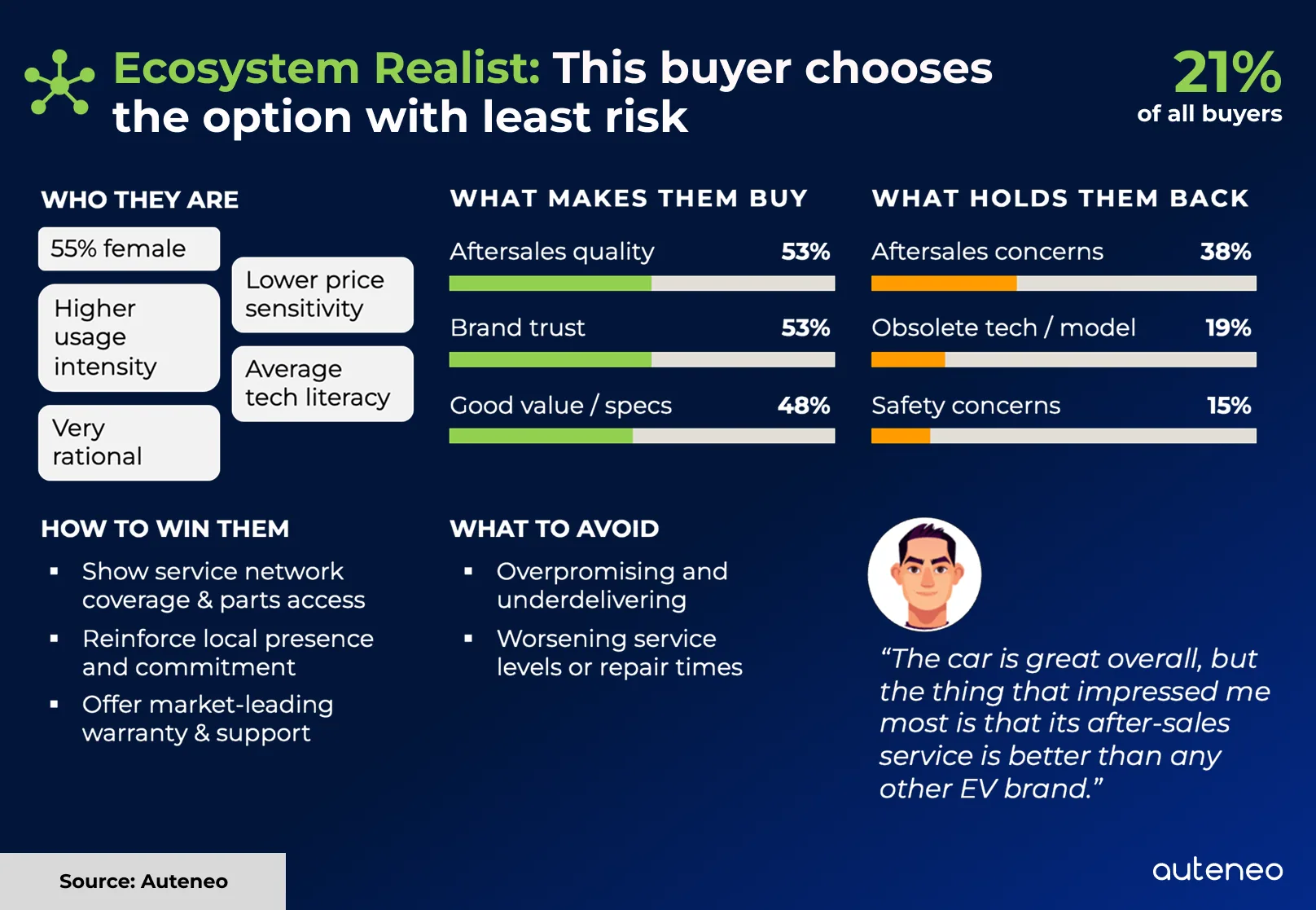
Their barriers mirror their motivations with uncomfortable precision. Aftersales concerns rank first at 38%, which creates a near-paradox: the thing that attracts them most is also the thing they are most worried about not getting. They are aware that Ora Good Cat has an established presence in Thailand relative to newer Chinese entrants. But they also know that EVs as a category still carry a poor after-sales reputation — particularly around parts availability — and that reputational drag applies to every brand in the segment regardless of individual track record. Safety concerns and technology obsolescence complete their top three barriers, both at 19%.
The ROI Commuter: monthly savings are the primary driver
Like the Ecosystem Realist, the ROI Commuter is a heavier-than-average daily driver. This is the buyer for whom a petrol car has become a genuine financial burden. The EV decision is not aspirational. It is a relief calculation — and the Good Cat is first evaluated almost entirely through that lens. Operational savings dominate their motivations at 91%, a figure so dominant it leaves little analytical room for anything else. Good value and specs follow at 51%, while aesthetics rank third at 45%.
Their barriers are telling. Aftersales concerns lead at 30% — consistent with their heavy usage profile, where a car out of service for too long can be a material financial disruption. Price and value drop concerns rank second at 19%: this buyer has done careful fuel-savings math, and a sudden price reduction by the manufacturer directly erodes the investment thesis they built their decision on. Battery longevity rounds out the top three at 17%, for the same reason — the savings calculation only works if the battery performs as expected over the ownership period.
What this means for marketing, sales, and product communication
These differences are not just analytically interesting. They have direct consequences for how the brand communicates, prices, and sells. Four distinct buyer personas sharing the same model creates both an opportunity and a trap. The opportunity is reach — the Good Cat has genuine appeal across a wider motivational spectrum than most competitors. The trap is assuming that a single campaign voice can serve all four groups without diluting the message for each of them.
Aesthetic Devotees need design-led creative as the entry point, but creative alone does not close the sale. Accessible price communication and visible social proof from existing owners are what convert emotional attraction into a signed order. Overloading them with specifications or complex financing works against the decision.
Spec & Value Maximizers already know the specifications. What they want is a credible answer to the technology roadmap question — how does this platform hold up over time, and what is the brand's commitment to keeping the model fresh? Announcing technology changes too far in advance, however, gives this persona a reason to wait rather than buy.
Ecosystem Realists cannot be won with promises. They need evidence — service network coverage, parts availability, warranty terms, and demonstrated local commitment. Overpromising on after-sales and underdelivering is the fastest way to permanently lose this buyer.
ROI Commuters need the math made explicit and pricing kept stable. A clear ICE-versus-EV savings calculator and transparent total cost of ownership communication address their core decision criteria. A sudden price drop after purchase actively destroys the trust of the buyer most likely to recommend the car to others.
At the dealer level, these distinctions matter as much as they do in marketing. A buyer arriving with a printed spreadsheet comparing four models is not the same conversation as one asking about color options. Sales staff trained on a single pitch will systematically underserve three of the four personas standing in front of them. Recognizing which buyer you are talking to — and adjusting accordingly — is where persona intelligence translates into actual commercial outcomes.
The broader point
The Ora Good Cat is not a niche product with a niche buyer. It has found genuine commercial traction across a wide range of motivations, usage profiles, and decision styles. That is a strength — but it pays for the brand to understand who it is actually talking to at any given moment.
The temptation for marketing teams is to build a single customer picture and communicate to it consistently. The data argues against it. An emotion-led design buyer, a spreadsheet-driven value optimizer, a risk-averse long-horizon thinker, and a financially-pressured commuter doing fuel savings math are not variations of the same person. They need different messages, respond to different triggers, and can be lost to the same competitors for entirely different reasons.
Equally important is that customer personas do not stay still. For example, as EV adoption matures in Thailand and more buyers are switching from one electric vehicle to another rather than from petrol, the share of the ROI Commuter in total may eventually go down. Or, prices dropping may bring in more Spec & Value Maximizers. New personas may emerge. Existing ones may evolve.
By utilizing latest technology advancements and new social listening approaches, running this kind of behavioral analysis periodically is no longer a research luxury. It is how brands avoid building strategy on a customer that no longer exists.