12 May 2026

Less than a year on from our original study, Thailand's public EV charging landscape looks broadly familiar — but the details tell a more nuanced story.
In August 2025, we published our first deep dive into the public EV charging experience in Thailand, drawing on data from online conversations. The picture that emerged was one of a market with real momentum but uneven execution: hardware failures topped the complaint list, charging spots were regularly blocked by inconsiderate parkers, and app experiences left much to be desired.
Now, with tens of thousands additional electric vehicles on the road, we revisit the question: is the experience getting better or worse?
Approach to Data
For this follow-up study, we analyzed 3,554 statements drawn from 2,569 public social media posts, covering top 10 most popular BEV models sold in Thailand in Q1 2026. The data covers March and April 2026.
Overall Sentiment: Stable, with Caveats
At a headline level, public EV charging sentiment has remained broadly unchanged. Negative statements account for 39% of the total (up marginally from 37%), while positive statements stand at 32% (down from 35%). However, the 2026 figures were shaped in part by improved filtering of promotional content by our AI model, which tends to suppress positive noise. Accounting for this, the most reasonable interpretation is that overall sentiment has stayed largely the same.
This stability is, in itself, meaningful. Thailand's BEV fleet has grown considerably since 2025, putting more pressure on public charging infrastructure — yet the experience has not materially deteriorated. That points to real progress in network expansion keeping pace with demand.
What's Improved
Few areas stand out as improvements.
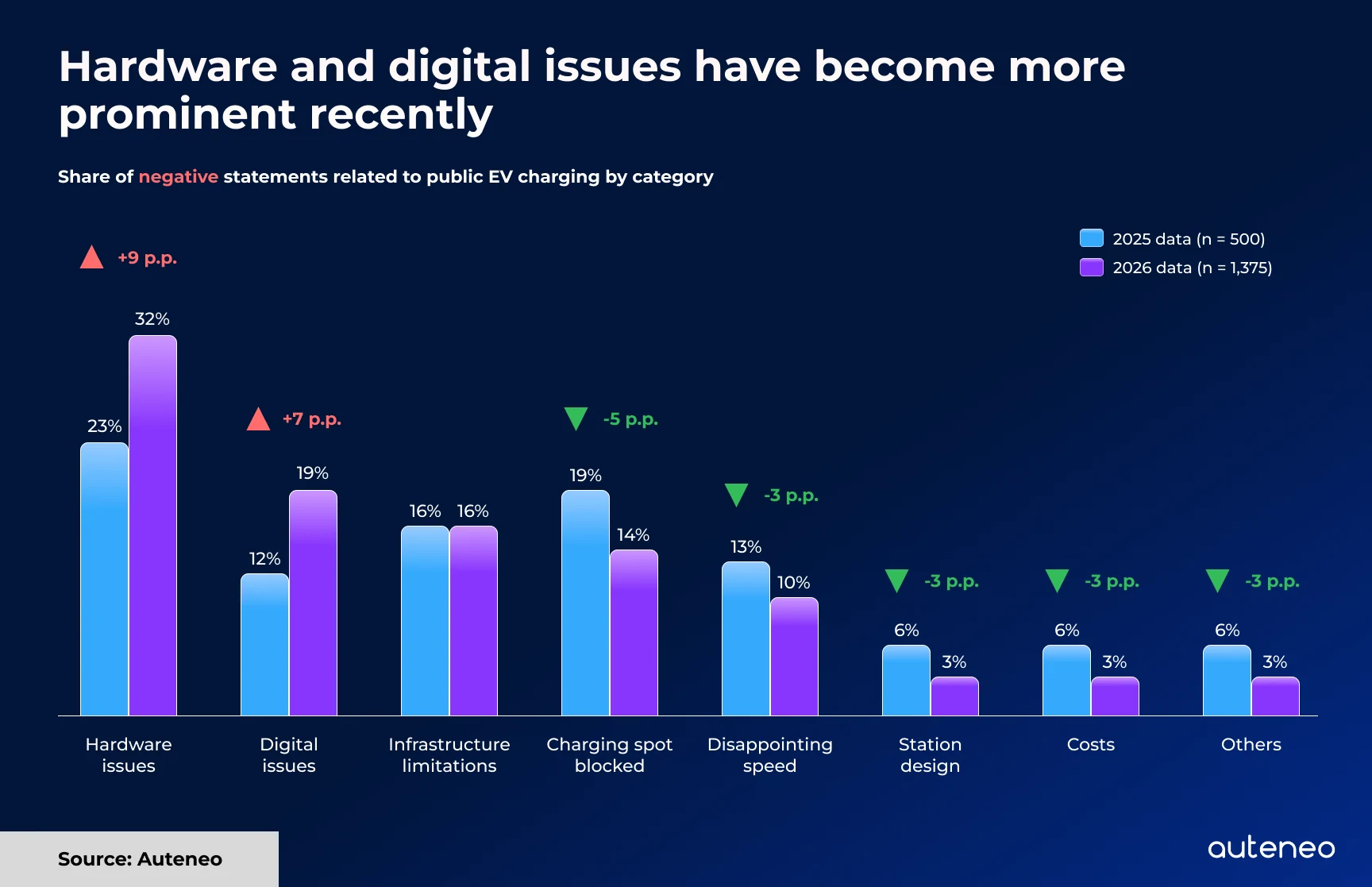
- Charging speed complaints have fallen, dropping from 13% of negative statements to 10%. This might be reflecting the continued rollout of fast-charging networks across the country, as well as growing familiarity among drivers with what to realistically expect from their vehicles and charging locations.
- Cost complaints have also declined, from 6% to 3%. Rising fuel prices have made the cost-per-kilometre advantage of EVs more apparent to consumers, shifting perceptions of EV running costs even where charging tariffs have remained largely unchanged.
- Charging spot blocking has decreased as well, from 19% to 14% of negative statements. The growth of dedicated EV charging hubs — where the entire facility is purpose-built for electric vehicles — has likely helped reduce the frequency of ICE-ing incidents that previously generated significant frustration.
What's Worsened
Two categories have moved meaningfully in the wrong direction.
Hardware reliability has risen sharply, from 23% of negative statements in 2025 to 32% in 2026. This is now the single largest driver of negative sentiment by a significant margin. The complaints span connection failures, interrupted charging sessions, compatibility mismatches, and stuck or malfunctioning charging cables. As the charger network scales up — and as more vehicle models with varying charging implementations enter the market — these friction points are becoming more, not less, common.
Digital issues have surged from 12% to 19%, moving from fourth place to second in the complaint rankings. A significant portion of this increase traces to issues related to a leading Charge Point Operator (CPO), which generated widespread complaints around registration errors, a cumbersome identity verification process, and a booking system that users found unreliable. As charging platforms become more central to the experience, their shortcomings are increasingly central to user frustration.
Blocked Spots: A Disproportionate Conversation Driver
One finding from the 2026 data deserves particular attention. While charging spot blocking has declined as a share of negative statements, it generates by far the most discussion — accounting for 29% of all comments across the dataset, nearly double its 14% share of original posts.
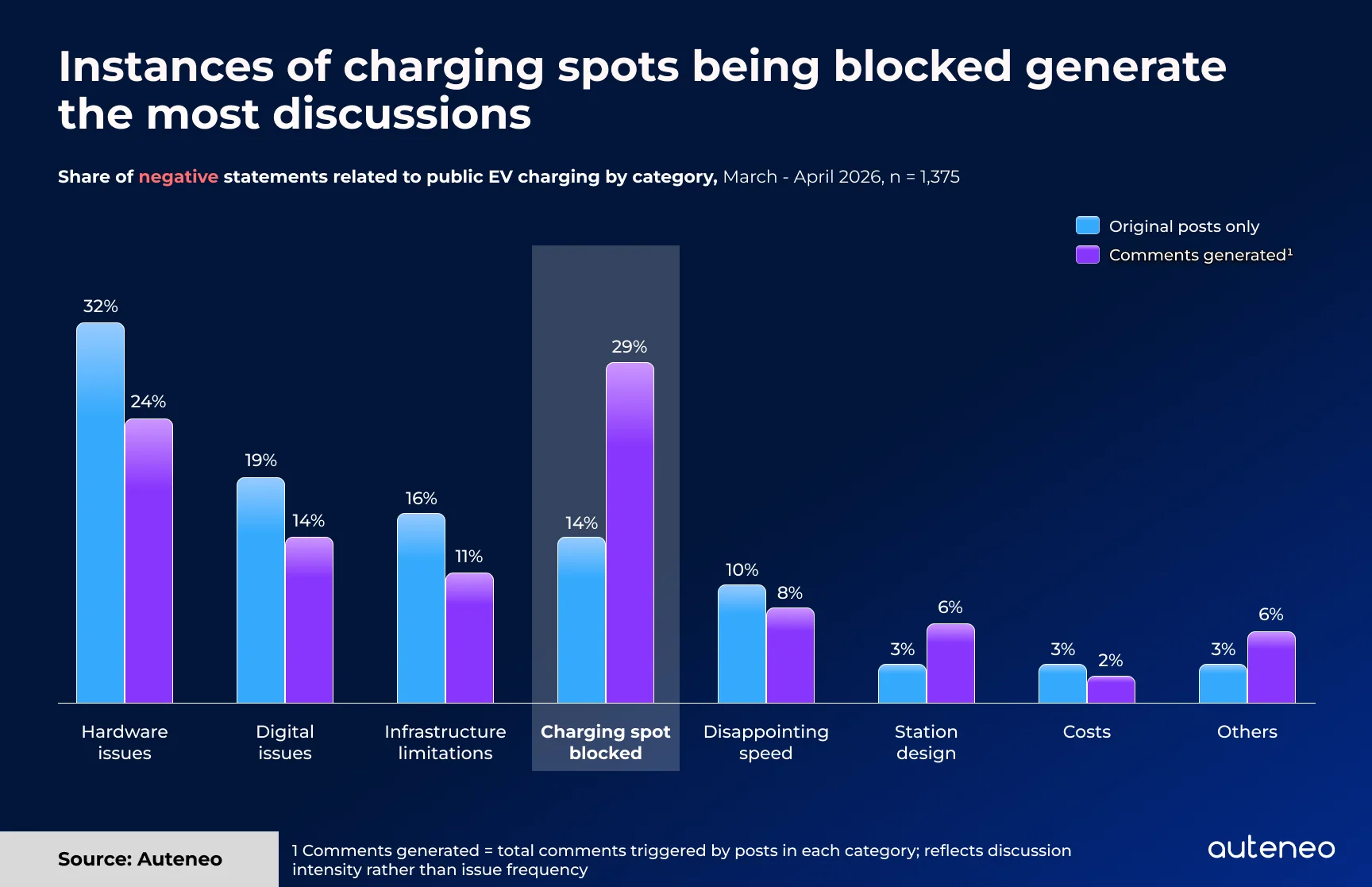
The explanation is straightforward: being blocked from a charging spot can escalate quickly. In some cases, disputes between drivers become heated enough to attract significant public interest and community participation. This dynamic means that even a relatively contained problem can punch well above its weight in shaping public perception of the EV charging experience.
The Brand Dimension
Across brands, there are no major differences in overall sentiment — the charging experience, for better or worse, is relatively consistent regardless of which car you drive. Notably, in this article, our dataset did not include Tesla which offers a network of superchargers as Tesla did not make the top 10 in sales in Q1 2026.
Hardware issues, however, vary considerably by brand. One brand in the study stands out sharply, with hardware complaints accounting for 49% of its negative statements — far ahead of any other. The issues described include stuck or incompatible charging heads, DC charging cutoffs, post-charge gear lock, and error messages that prevent the car from starting or moving after a session, often requiring multiple visits to a service center to resolve.
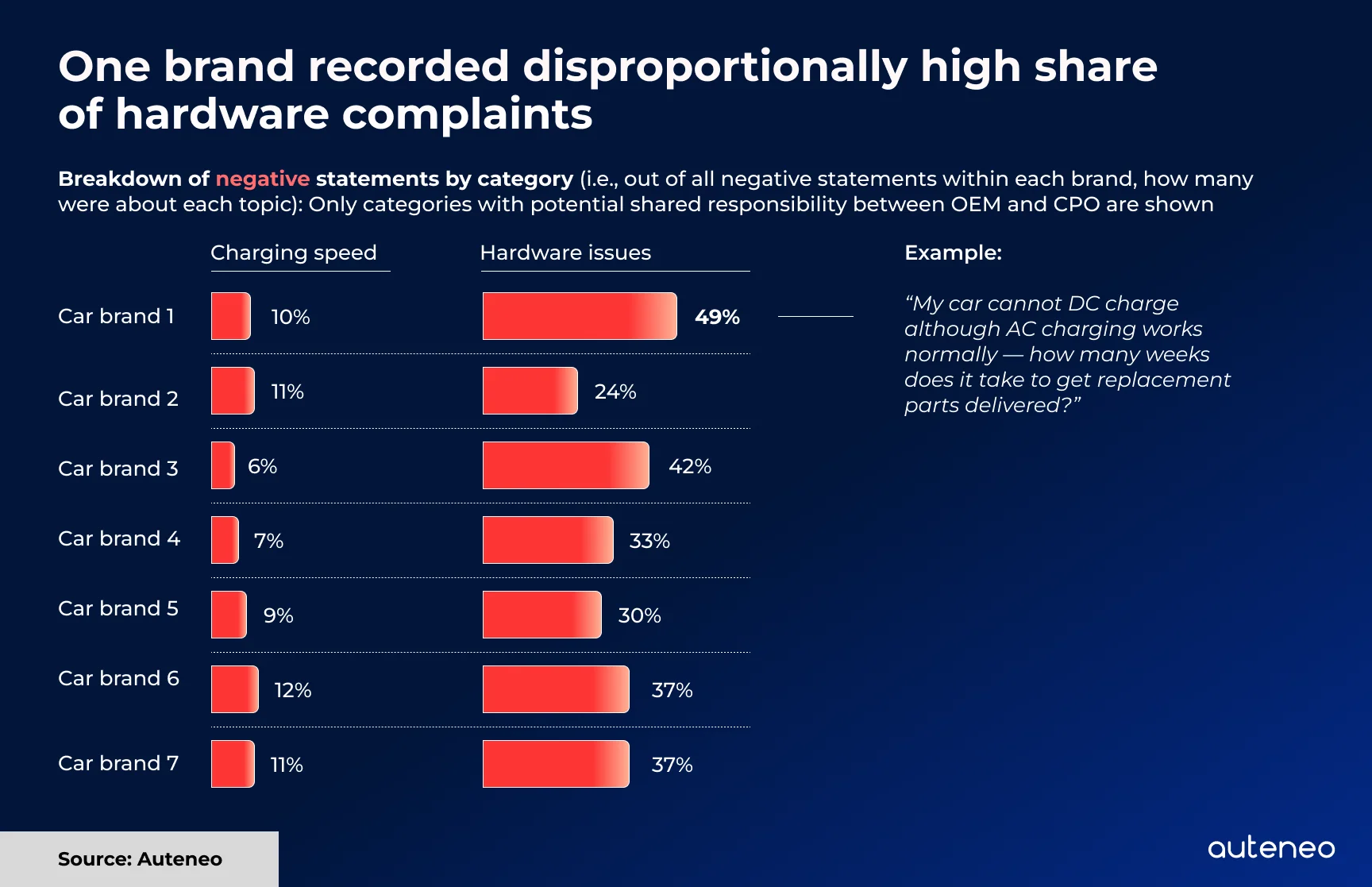
At the other end of the spectrum, several brands cluster around 30–37% — broadly in line with the market average — suggesting that for most owners, hardware friction is an ecosystem problem rather than a vehicle-specific one. That said, it remains worth monitoring at the individual brand level, given the direct link between charging reliability and long-term ownership satisfaction.
What It Means
The 2026 findings reinforce a conclusion from our earlier study: the public charging experience in Thailand is a shared responsibility, sitting across vehicle manufacturers, charge point operators, and platform developers — and the failures in one area amplify frustrations in others.
When a charging session is interrupted, a driver often cannot tell whether the problem lies with the vehicle, the charger hardware, or the app managing the session. That ambiguity compounds frustration and erodes confidence in the EV proposition more broadly. But when the source of failure is clear, the consequences become more targeted — and in some ways more severe.
For charge point operators (CPOs), hardware failures that are visibly attributable to a specific network carry a particular reputational risk. Drivers who experience repeated problems at the same CPO's stations don't just complain — they begin actively routing around that network, opting for competitors even when it means less convenience. In a market where charging habits and brand loyalties are still forming, that kind of avoidance behaviour can be very difficult to reverse.
For OEMs, the stakes are different but equally significant. Charging is no longer a peripheral part of the ownership experience — it is central to it. When complaints about charging failures are clearly linked to the vehicle itself, whether through compatibility issues, software handshake failures, or hardware design, they feed directly into purchase consideration. Prospective buyers read these discussions. A model with a visible charging problem in public forums faces headwinds that no amount of positive press coverage fully offsets. Software compatibility, in-cabin diagnostics that explain what is happening during a session, and native integration with charging platforms are increasingly competitive differentiators — and their absence is increasingly a reason not to buy.
For platform developers, the issues seen with certain charging apps in this study are a case study in what happens when digital onboarding is not matched to the scale of user demand. The friction created at registration and verification stages reaches users at exactly the moment they need reliability most.
It's Still Not All Bad
Positive conversations remain a substantial share of the total, and the categories driving them are telling. Infrastructure availability is the top driver of positive sentiment (28%) — drivers are noticing and appreciating the expansion of the network. Fast charging speed follows at 16%, and attractive costs at 22%, reflecting the growing perception that charging an EV is meaningfully cheaper than fuelling a combustion engine.
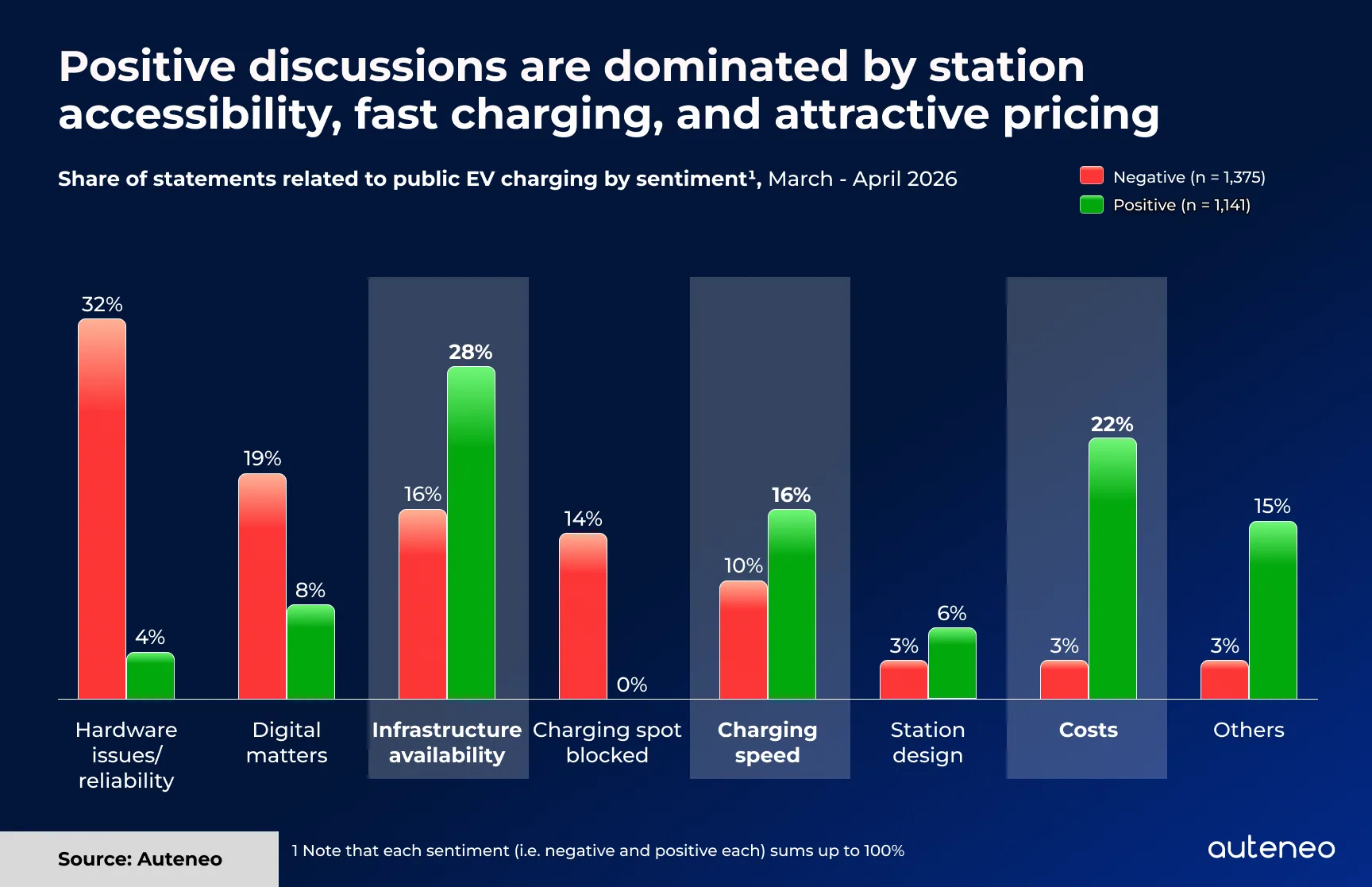
Notably, the fact that positive sentiment has held up at all is significant in itself. Thailand's BEV fleet has grown considerably since 2025, meaning more drivers are using public charging more frequently — yet the share of positive experiences has not collapsed under that pressure. That points to real underlying progress, even if it is unevenly distributed.
Final Words
Thailand's public EV charging network has held up under the pressure of a growing fleet, and in several meaningful ways the experience is improving. But hardware reliability and digital friction are moving in the wrong direction, and they are doing so in areas that directly affect whether a driver can charge their car at all.
The standard is rising. EV owners are no longer willing to accept unreliable hardware or clunky apps as a necessary inconvenience of early adoption. Meeting that expectation requires the entire ecosystem — OEMs, CPOs, and platform developers — to treat the charging session not as a secondary concern, but as a core part of what they are selling.
Want to learn more about how Auteneo can address your insight needs?
Contact us here.